
How Has Salesforce Become a True Multi-Framework Development Platform?
Salesforce just opened its runtime to the modern web. Here is what it means for developers, customers, Agentforce — and why KVP's long bet on rich React UIs suddenly looks even more relevant.
What is Salesforce's multi-framework platform and why does it matter?
Modern web teams want React, Vue or Angular. Salesforce teams have been locked into LWC. That gap is now closing.
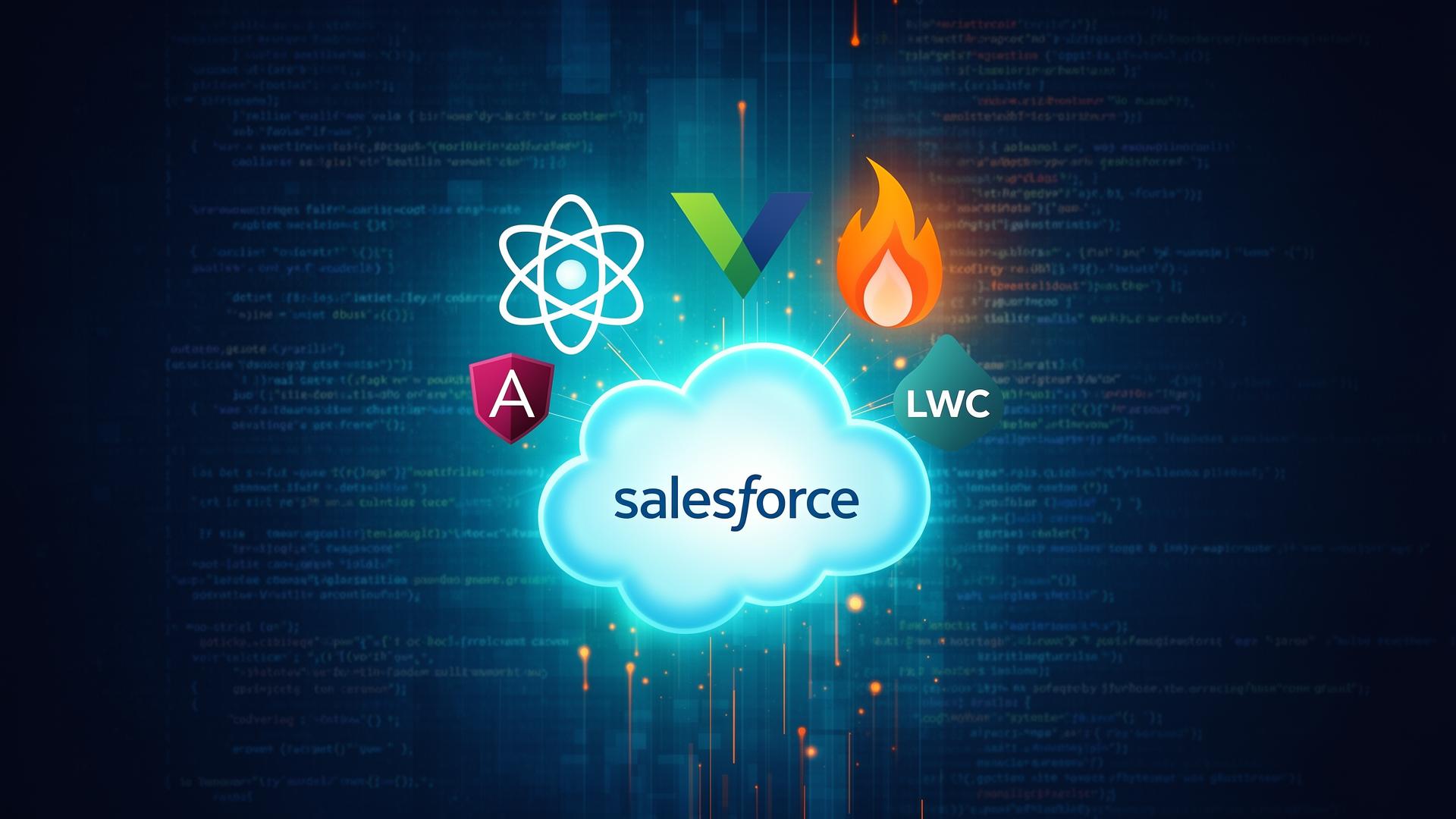
Salesforce's multi-framework platform lets developers build apps on Lightning Web Runtime using React, Vue, Angular, Svelte or LWC — sharing the same metadata, security, Data Cloud and Agentforce bindings. It widens the talent pool, modernises UX, accelerates Agentforce adoption, and signals a more open, composable Salesforce. KVP brings 12+ years of React-on-Salesforce experience to help customers adopt it safely.
Four Development Surfaces on One Platform
What Salesforce announced
Lightning Web Runtime — the engine that powers Lightning Experience and Experience Cloud — now hosts React, Vue, Angular and Svelte components alongside Lightning Web Components. Every framework taps the same Salesforce primitives:
- Shared metadata, permission model and Lightning Locker security
- Native bindings to Data Cloud, Apex, Flows and the metadata API
- First-class Agentforce hooks — every component can host or trigger an agent action
- Unified design system tokens so multi-framework apps still look like Salesforce
Why Salesforce adopted this
1. The talent reality
There are roughly 20 million React developers worldwide and a fraction of that for LWC. Locking customers into one framework was a tax on hiring, onboarding and total cost of ownership.
2. Modern UX expectations
Customers, partners and employees expect app-like, animated, AI-native experiences. The richest patterns — drag-and-drop canvases, streaming chat, generative UI — already live in the React/Vue ecosystems.
3. Agentforce composability
Agentforce, Headless 360, Heroku AppLink and MCP all push toward a composable runtime. Multi-framework support is the UI layer of that strategy — any front end can be an agent surface.
4. Compete on openness
Hyperscalers (AWS, Azure, GCP) and rivals (ServiceNow, Microsoft) compete on openness. Salesforce had to follow — or risk losing greenfield AI projects to bring-your-own-stack platforms.
Impact on Agentforce and AI agents
Multi-framework is not just a developer convenience — it is the missing UI layer for agentic Salesforce.
- Generative UI: React's streaming and Suspense models let agents render components on the fly — forms, tables, charts — conditional on the user's intent.
- Agent canvases: Rich React canvases (think Linear, Notion, Cursor) become possible inside Salesforce, hosting multi-step agent workflows.
- MCP everywhere: Combined with the new MCP tools and Agent Script, any UI built in any framework can call agent actions and tools.
- Faster experimentation: Product teams can prototype agent experiences in a familiar stack and ship into Salesforce without rewriting.
Where this fits in the Salesforce roadmap
Read multi-framework alongside the other 2025–26 announcements and the picture is consistent:
Headless 360 turned Salesforce into infrastructure for AI agents. Read our analysis →
Agent Script & MCP tools made every Salesforce capability callable by an agent.
Heroku AppLink made any externally hosted service feel native to Salesforce.
Multi-framework UI closes the loop: bring your stack, your talent and your design system — and ship it on Salesforce metadata.
Expect the next 12–18 months to bring AI-generated component scaffolding, Lightning Out v2 for embedding Salesforce UI anywhere, and tighter design-system parity across frameworks.
KVP perspective: built for this moment
We did not wait for multi-framework to ship rich UIs on Salesforce. For over a decade KVP has built React, Next.js and Node-based experiences that wrap Salesforce when the platform alone could not deliver the UX. Multi-framework support brings those patterns inside the platform — which is exactly where we want them.
Where we have shipped React on Salesforce
- Customer & Distributor portals with Salesforce as the system of record
- Hospitality CRM and Travel Agent solutions with map & calendar UIs
- Real-estate broker portals and WhatsApp-integrated dashboards
- AI-native co-pilots embedded in Sales Cloud and Service Cloud
- Investor intelligence platforms for growth equity firms
KVP differentiation
- Cross-stack squads: React + LWC + Apex + MuleSoft + Data Cloud
- Reusable React component library mapped to Salesforce design tokens
- Visualforce / Aura → React-on-LWR migration playbook
- Agentforce-ready React shells with embedded agent actions
- Performance, accessibility & security baked in to ship-ready patterns
Who benefits — and how
Developers
Use the framework you already love. Bigger talent pool, faster onboarding, modern tooling, less context switching between Salesforce and the rest of your stack.
Customers
Faster time-to-value, lower talent costs, modern UX for employees and customers, and a future-proof investment as Agentforce scales.
The Salesforce ecosystem
A larger, more diverse developer community, accelerated Agentforce adoption, and a credible answer to open hyperscaler stacks.
Ready to ship a React experience on Salesforce?
KVP runs a 4-step adoption: rapid assessment → pilot component on Lightning Web Runtime → reference architecture → scaled rollout with Agentforce hooks. Talk to our engineering team.
Frequently asked questions
What does Salesforce 'multi-framework' actually mean?
Salesforce now lets developers build UI on the Salesforce platform using React, Vue, Angular, Svelte and Lightning Web Components — all running on the same Lightning Web Runtime, with the same metadata, security model, Data Cloud bindings and Agentforce hooks.
Is LWC going away?
No. LWC remains a first-class citizen and is still the most tightly integrated framework. Multi-framework support adds choice for teams that already invest in React, Vue or Angular — they no longer need a separate runtime to ship Salesforce-grade experiences.
How does this affect Agentforce and AI agents?
Modern frameworks unlock generative-UI patterns — streaming responses, dynamic component rendering, agent canvases — directly inside Salesforce. Any React or Vue surface can host an Agentforce action, making the front-end a first-class agent surface.
Can we migrate our existing React app to Salesforce?
Yes. KVP's playbook lifts React/Next.js codebases onto Lightning Web Runtime, swaps API calls to Salesforce metadata and Data Cloud, and wires authentication and design tokens — typically in 6–10 weeks for a pilot module.
Why did KVP invest early in React for Salesforce?
Our customer portals, distributor portals, hospitality and travel accelerators have used React-rich UIs for years to deliver experiences LWC alone could not. Salesforce's multi-framework move validates that direction and lets us bring those patterns inside the platform itself.