
Quick Answer
What value does Agentforce Tender Intelligence create?
Tender qualification should not burn hundreds of pre-sales engineering hours on documents you will ultimately reject. KVP's Government Tender Intelligence asset autonomously monitors procurement portals, digests complex RFP documents page by page and provides evidence-backed bid/no-bid recommendations — right inside Salesforce. The value targets are protected pre-sales bandwidth, fewer compliance oversights and days of extra runway for proposal teams. These are design targets to be measured in a pilot, not guaranteed results.
The business impact at a glance
| Strategic metric | The traditional reality | With Agentforce Tender Intelligence |
|---|---|---|
| Time to bid/no-bid decision | 3 to 5 business days spent manually downloading, reading and summarising RFPs. | Full extraction, automated scoring and an executive summary targeted in under 30 minutes of processing. |
| Pre-sales engineering capacity | Up to 40% of bandwidth absorbed vetting unviable specs, impossible lead times or misaligned criteria. | Focused on high-probability opportunities, protected by evidence-based qualification gates. |
| Pipeline capture rate | Viable tenders slip through due to manual portal-refresh fatigue and tight submission windows. | Continuous discovery coverage across monitored portals, aligned to your core capabilities. |
| Compliance and audit security | Risk of disqualified bids from overlooked clauses, missing annexures or silent specs. | Explicit gap analysis that flags unconfirmed clauses and risks rather than guessing. |
The right-hand column describes design targets from the asset's specification. Confirm actual timings and capacity effects with measured pilot data before quoting them externally.
Why enterprise bid teams need Agentforce Tender Intelligence
Stop wasting high-value engineering on dead-end bids
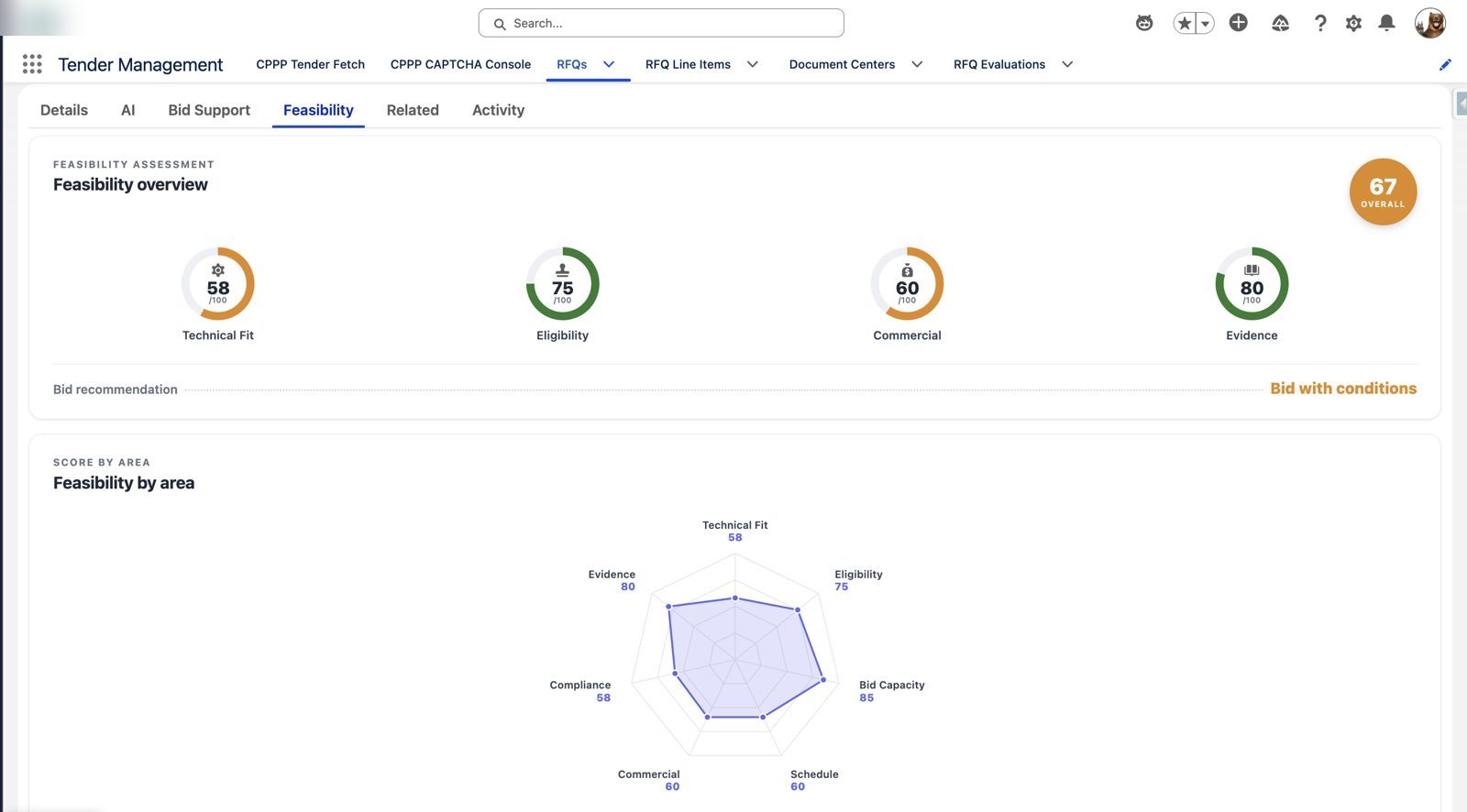
Every hour your senior technical leads spend combing through 200-page tenders to determine basic eligibility is an hour not spent refining pricing models or client relationships. The asset scores each notice across seven feasibility dimensions — technical fit, schedule viability, commercial terms and execution risk — giving you the facts needed to make aggressive, defensible No-Bid decisions early.
Built for enterprise governance: AI with full source traceability
Unlike generic generative tools that can hallucinate answers, this asset operates with strict human-in-the-loop governance. Every extracted requirement, delivery milestone and earnest money figure is mapped directly back to the source tender page. If a specification is ambiguous or silent on key requirements, the agent highlights the missing information instead of fabricating an answer — providing your team with ready-to-send clarification questions for the buyer.
Immediate proposal orchestration inside Salesforce
A Bid decision automatically triggers your execution playbook on the tender record: countdowns for query submissions, pre-bid meetings and final submission deadlines; cross-functional work packages allocated to legal, estimation and commercial teams; and buyer corrigenda and document revisions centralised in one system of record — eliminating version-control chaos across spreadsheets and inbox threads.
KVP view: value you can audit, not value you assume
Measure the before state first. Record how long qualification takes today, how many tenders are missed and how much senior engineering time goes into rejected bids. Without that baseline, the asset's contribution cannot be proven — only asserted.
Keep the decision human. The recommendation is computed by fixed rules and explained in plain English, with gaps shown honestly. KVP recommends approval gates for the bid decision, for proposal content and for final portal submission. The AI prepares the evidence; accountable people decide.
Start with one portal and one category. The demonstrated build searches CPPP; GeM coverage is scoped separately. A bounded pilot on representative tenders validates extraction accuracy, missing-information handling and review workload before any expansion.
Where KVP can help: define the pilot scope, map the Salesforce record model, configure the seven-dimension scoring, and set up the measurement plan. See the full walkthrough on the asset page.
Frequently asked questions
What business value does Agentforce Tender Intelligence create?
It reduces the manual effort of finding, reading and qualifying government tenders. Relevant tenders arrive in Salesforce automatically, documents are extracted page by page, and a bid recommendation with reasons and gaps is produced before the team opens a single PDF. The value targets are faster qualification, protected pre-sales capacity and a complete audit trail — these are measurement targets, not guaranteed results.
How much faster is the bid/no-bid decision?
The design target is to move from days of manual reading to an initial evidence-backed recommendation in under an hour of processing, depending on document volume. Actual timings depend on tender size, portal access and review workload, and should be measured during a pilot.
Does the AI make the bid decision?
No. The recommendation is computed by fixed rules across seven feasibility dimensions and explained with reasons, conditions, buyer questions and items the documents did not confirm. Bid managers make the final decision.
How does it protect against compliance mistakes?
Every extracted requirement, milestone and amount is mapped back to the source tender page. Where documents are silent or ambiguous, the agent flags the gap instead of guessing, so teams can send clarification questions to the buyer before committing.
Which portals are covered?
The demonstrated build searches the Central Public Procurement Portal (CPPP). GeM and other portals are separately scoped integration targets; coverage is confirmed during implementation scoping.
What happens after a Bid decision?
A Bid decision triggers the execution playbook on the tender record: countdowns for queries, pre-bid meetings and submission deadlines, work packages allocated to legal, estimation and commercial teams, and corrigenda centralised on one record.
Sources and editorial scope
Reviewed October 17, 2026. Figures such as decision time and capacity protection are design targets from the asset specification, not measured customer results. Portal coverage, licensing and consumption costs are confirmed during scoping.
 Tender intelligence